First steps
How to equalize your ears when diving and avoid pain
By Álvaro Silva · · 10 min read
To equalize your ears when diving, you pinch your nose and blow gently, and you do it from the surface and very often on the way down, before you feel any discomfort. It's the most common problem when someone is learning, and in more than 35 years as an instructor I've seen it in beginners and in certified divers. People always ask me: Álvaro, won't my ears equalize on their own? No, they won't. You have to equalize continuously, and if you do it in time, your dive gets off on the right foot.
Video in Spanish
What is equalizing in scuba diving?
Equalizing means matching the pressure of the air inside your middle ear to the pressure of the water around you. That air space is connected to your throat by the Eustachian tube, and that's the way the air goes when you equalize.
As you go down, the water pushes your eardrum inward. That membrane is one of the most sensitive parts of the body: it's so sensitive that we pick up sound waves through it. If the pressure isn't equalized, the membrane gets pushed out of shape, and that hurts.
The first few meters are the hardest on your ears. At the surface you have 1 bar over you, which is the pressure of the atmosphere. At 10 m (33 ft) it's already 2 bar: the pressure doubles and the air in your ears shrinks to half. Deeper down, the change gets smaller and smaller:
| Depth | Pressure | Air volume |
|---|---|---|
| Surface | 1 bar | Full |
| 10 m (33 ft) | 2 bar | Half |
| 20 m (66 ft) | 3 bar | A third |
| 30 m (100 ft) | 4 bar | A quarter |
How do you equalize your ears when scuba diving?
The most common way is the Valsalva maneuver: you pinch your nose through the mask and blow gently through your nose, with your mouth closed. Since the air can't get out, it goes back, through the Eustachian tube, and evens out the pressure.
Gently means gently: you're not blowing up a party balloon. PADI warns that blowing too hard can injure your ear, and if you equalize early, a light puff is all you need. That's why your mask has to fit so your nose is comfortable and easy to pinch.
There are other ways, and you can combine them with a gentle Valsalva:
- Swallow. If you pinch your nose while you swallow, that's what PADI calls the Toynbee maneuver.
- Push your jaw forward. You'll notice a hollow feeling in your ear: that's the Eustachian tube opening.
- Act as if you're about to yawn, but don't actually yawn: the regulator can slip out of your mouth and you get a mouthful of water.
- Press your tongue hard against the roof of your mouth, or pull it back. That also helps clear the tube.
- Chew gum on the way to the dive if you find it hard to equalize. Moving your jaw loosens up the Eustachian tube, and since you can't do that underwater, do it beforehand.
When should you equalize your ears while diving?
From the surface and the whole way down, before you feel any discomfort. If you wait until it hurts to equalize, you're doing it wrong.
I get divers from different countries who start equalizing at 3 or 4 m (10 or 13 ft). That's already too late. I teach it like this: as soon as you deflate your BCD and start going down, you equalize at 50 cm (20 in), again at 1 m (3 ft), and so on, very often through the first 10 m (33 ft). PADI says the same: equalize early and often. Some divers equalize with every breath on the way down.
Past 10 m (33 ft) the changes are less drastic, but you keep equalizing. Your ear is also an instrument: if the pressure builds, you're going down; if it clears, you're going up.
On the way up you don't have to do anything: the air expands and escapes on its own. And with kids, take twice the care: they get in so excited that they forget to equalize. Go down slowly with them and keep giving them the signal.
Why do my ears hurt when scuba diving?
They hurt because you didn't equalize in time: the Eustachian tube closed, the air can't get through anymore and the water pushes your eardrum inward.
In beginner courses I see it fairly regularly: out of nerves, excitement or forgetfulness, the student doesn't equalize in time and the tube collapses. Some keep going down in pain, thinking it will go away. It doesn't. If you keep going, you can end up with a ruptured eardrum: very intense pain, dizziness, nausea and disorientation, because the ear is part of the body's balance system.
These are the five mistakes I see most often:
- Equalizing when it already hurts. By then the Eustachian tube has collapsed, and no matter how hard you blow, the air won't get through.
- Forcing the Valsalva. If you equalize from the moment you leave the surface, there's no need to blow hard.
- Dropping like a stone. If you go down too fast, you don't have time to equalize and the tube gets blocked.
- Going down head first or looking down. That angle of the neck closes the Eustachian tube. In the course we teach you to go down feet first, as PADI recommends, slowly and with your neck straight or looking up.
- Going down with your eyes glued to your dive computer. It gives you a lot of information, but it will never flash a sign that says equalize your ears.
What to do if you can't equalize your ears?
Stop going down, go up until your ear feels comfortable and try again, gently. If you still can't equalize, the dive is over.
Never force the air through, and never keep going down while it's uncomfortable. Signal your instructor or your buddy and go up a little together. Often, once it's comfortable, the ear clears with a gentle Valsalva or by moving your jaw. If there's no way after several tries, it's better to miss one dive than to hurt your ear: if you force it, you irritate that whole area and you'll most likely miss the rest of the day's dives too.
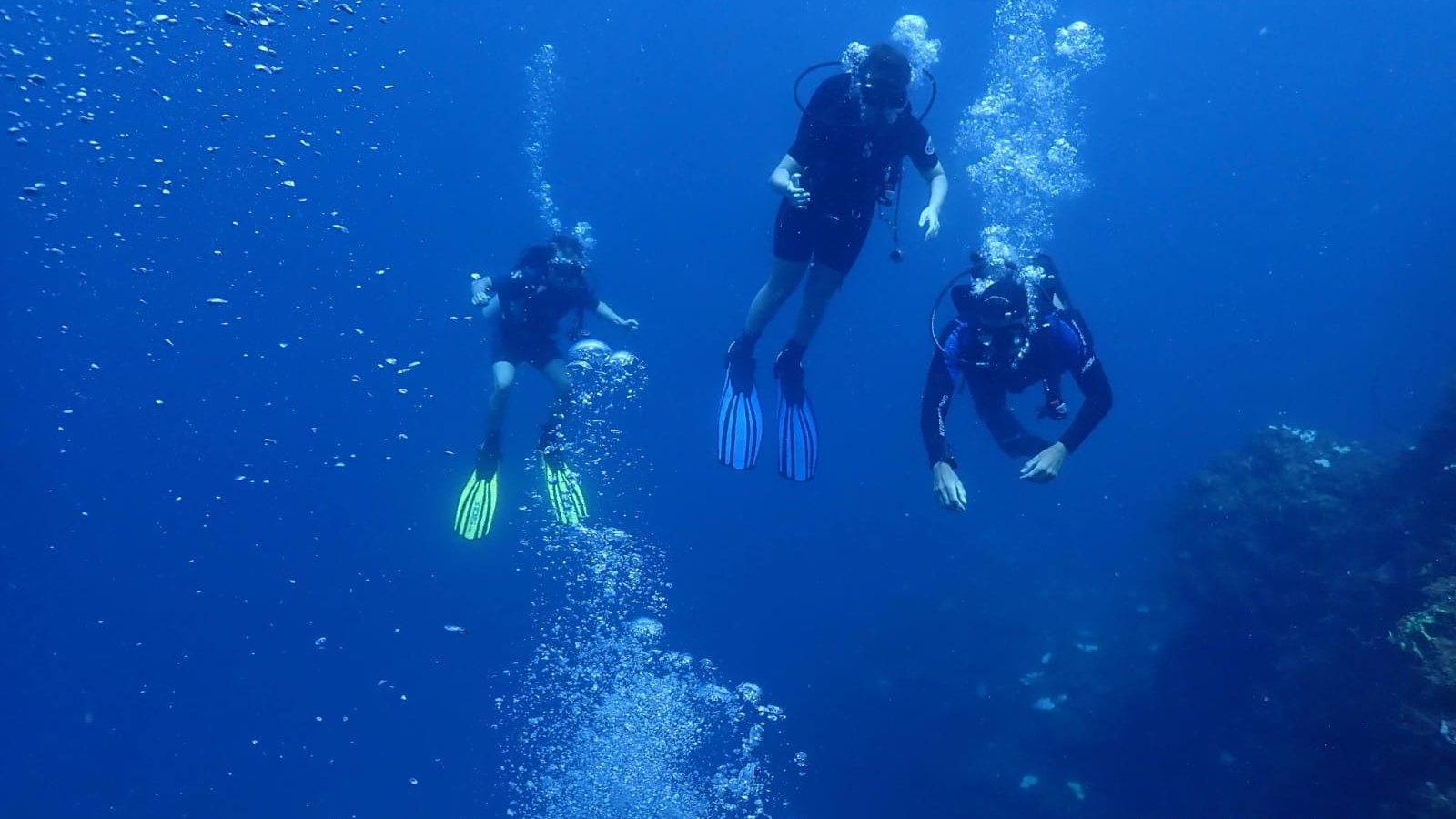
A trick that works: agree on this before you go down. On the descent, the group stops at 2 m (7 ft) to give each other the OK signal and check that everything is fine, ears included. That way you can all remind each other: equalize your ears.
Can you scuba dive with a cold?
No. With a cold or congestion the Eustachian tube gets blocked and you won't be able to equalize properly.
With a cold you blow your nose and your ears feel blocked. You don't go into the sea like that, however much you want to. And don't take medicine on your own to clear up and dive anyway: I've seen that relief wear off quickly. PADI puts it plainly: wait until you feel well, and if it doesn't go away, see a doctor.
Allergies are similar. My advice is to see an ear, nose and throat doctor, who is the one to tell you what to do. I know people with allergies who dive perfectly well by following what their doctor told them.
And on dive day, arrive rested, hydrated and with no alcohol in your system. PADI points out that alcohol and cigarettes irritate the mucous membranes and can block the Eustachian tube. Diving doesn't forgive a late night.
Why do I get dizzy when equalizing my ears?
Because one ear equalized before the other. Your brain reads that difference as movement that never happened, and the dizziness hits. It's called alternobaric vertigo.
It happens when one Eustachian tube is clearer than the other: one ear equalizes easily and the other gets there seconds later. What your eyes see doesn't match what your brain is processing, and you feel everything moving violently. It can bring on nausea and vomiting. It also happens on the way up, when the air leaves one ear before the other.
I've only seen it twice in my life, both times in people with bad allergies who thought they were healthy, because you can't see the swelling inside.
If it happens to you, hold on to your buddy, or to a rock if you're on the bottom, and fix your eyes on something that isn't moving until your brain understands again that everything is in order. To avoid it, go down very slowly, turning your head from side to side and moving your jaw while you equalize. And if the dizziness is still there once you're out of the water, you're done diving for the day and you go see a doctor.
Why does my ear hurt after scuba diving?
If your ear hurts after diving, don't get back in the water, and see a doctor. It could be a pressure injury or an inflammation, and it's the doctor who tells you which.
It happened to me once, for the first time in my life. I spent a weekend in the water with no ear trouble at all, and the next morning I woke up with a little discomfort. I went to the doctor and it was what I suspected: what they call swimmer's ear, a mild inflammation. The next day I was perfectly fine.
It happens when you spend a lot of time in the water, fresh or salt: the earwax, which is one of the ear's protective barriers, slowly dissolves, and bacteria can get in and inflame it.
What about earplugs? PADI is clear: you don't dive with earplugs. And if you wear a hood, make sure it doesn't squeeze your ears.
Learning to equalize in Portobelo
If you've never dived before, at Panama Dive Adventure, in Portobelo, you start with Discover Scuba Diving: $120, with the gear included, from age 10. Before going down, in shallow water, your instructor explains how to equalize and you practice it together. Then we go down slowly, equalizing the whole time, at your pace.
If you want to keep going, the Open Water course costs $540 and includes the PADI eLearning theory, the certification and the gear. In the courses there are no more than six students per instructor, in Spanish or in English. We head out every day at 8:00 am from the dive center and we're back around 1:00 pm.
And if you come down with a cold the day before, message us on WhatsApp and we'll find another date. Your ears will thank you.
Sources
- PADI: ear equalization and ear care for scuba divers
- PADI: how to equalize when diving
- PADI: how to descend and ascend safely
- PADI: diving physics, pressure and volume by depth
- PADI: Discover Scuba Diving, requirements and minimum age
- My video (in Spanish): Lo estás haciendo mal, vol. 4
- My video (in Spanish): 5 errores que probablemente estás haciendo
- My video (in Spanish): Los 5 errores que te ponen en peligro bajo el agua
- My video (in Spanish): 6 tips para diseñar tu buceo perfecto
- My video (in Spanish): Cómo escoger tu próxima máscara
- My video (in Spanish): Introduce a tu hijo en el mundo submarino, 10 tips y beneficios