Gear
How to stop a dive mask from fogging up
By Álvaro Silva · · 10 min read
To keep your dive mask from fogging, you have to prep it before its first dive and put anti-fog on it before every dive. I say that as someone who has been diving since 1978 and has prepped masks thousands of times, mine and the school's. When you buy a new mask, all your buddies tell you the same thing: it's going to fog, it's going to fog, it's going to fog. But yours is not going to fog on its first dive. Here are my four steps, including one I'm almost sure nobody has told you about.
Video in Spanish
Why does my dive mask keep fogging up?
A new mask fogs because it comes from the factory with a protective film of grease on the lens. That film protects it while it sits on display or in storage, but underwater it makes the glass fog from the start.
PADI explains it the same way: during manufacturing, the lenses are coated with a thin layer of silicone so they don't get scratched, and the mask keeps fogging until that layer wears off or you remove it.
With a mask that is already prepped, the fog comes from moisture condensing on the lens. According to PADI, three habits make it worse:
- Blowing air out through your nose. Underwater you breathe through your mouth, and you only exhale through your nose to clear the mask.
- Touching the inside of the lens, especially after putting anti-fog on it: the oil from your fingers stops it from working.
- Using a mask that doesn't fit you well. If water keeps getting in, that moisture helps it fog.
How do you prepare a new dive mask?
A new mask needs four steps before its first dive: flame on the lens, toothpaste, degreasing soap and boiling water. We call that prepping the mask.
You need a lighter, toothpaste, degreasing dish soap, paste or liquid, and a pot of boiling water. This is how I prep the new masks that come into the school: the one in the video went to work at the dive center the next day.
These are the steps, in order:
- Step 1: run the flame of a lighter over both lenses, never over the silicone.
- Step 2: spread toothpaste with your finger on the lens, the nose pocket and the silicone skirt, and rub until you have cleaned every bit of it.
- Step 3: wash it with plenty of water and degreasing soap, again with your finger, until it is squeaky clean.
- Step 4: dip it in boiling water for 12 seconds and move it straight into cold water.
Can you burn a dive mask with a lighter?
Yes, on the lens only and never on the silicone. PADI recommends that an experienced professional do it, because done wrong it can damage the mask.
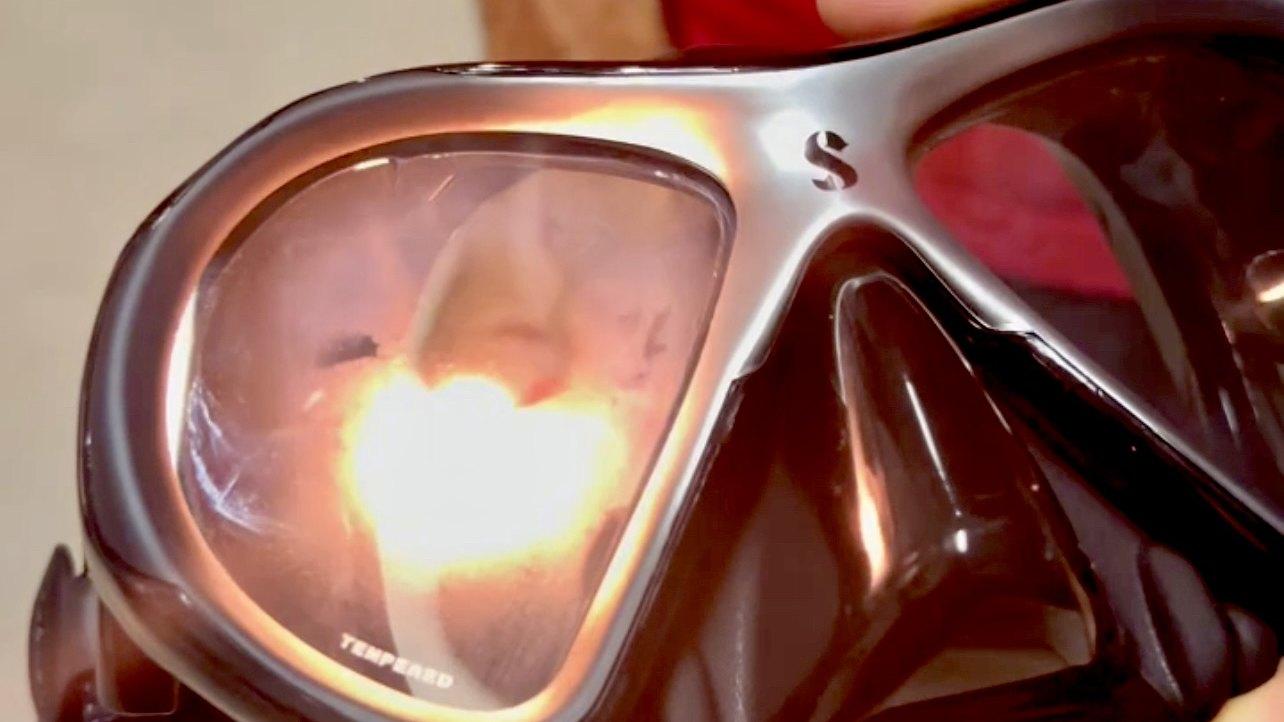
More than one person has told me: Álvaro, you've gone crazy. I haven't gone crazy: I've done it thousands of times and it works. Watch what happens when the flame touches the glass: a circle opens up. That is the factory grease burning off, those little bits stuck to the glass. The lens is left with black smudges. Don't wipe them off yet, because they come off with the toothpaste.
PADI describes how to do it: hold the mask level and keep the tip of the flame just under the lens and always moving, so the glass doesn't heat up in one spot. It also warns you to take great care not to burn or melt the skirt, and says the black soot is normal. If you've never done it, ask your instructor to do it with you, or go straight to the toothpaste.
Does toothpaste work on a dive mask?
Yes. Toothpaste cleans off the mark left by the flame and the factory grease, as long as you rub with your finger and not with a sponge.
Put a little on and work it with your finger over everything, absolutely everything: the edges, the inside, the nose pocket, the skirt. Rub, rub, rub, switch to the other lens and keep going. Toothpaste is already abrasive enough, so no sponges. Try to leave it barely pasty, as if it were already drying out.
Some people think it is enough to smear the toothpaste on, go to bed and wait for a miracle the next day. Absolutely nothing happens: the mask wakes up wearing a toothpaste costume, with nothing to show for it. What works is the combination of the four steps.
PADI adds two cautions: use a cream toothpaste, not a gel, and not a whitening one, because those contain small crystals that can scratch the glass. And never use a rough sponge or steel wool.
How do you clean a new dive mask?
After the toothpaste, you wash it with plenty of water and degreasing soap, and at the end you boil it for 12 seconds.
Soap it up with your finger and no sponge, because a sponge can scratch the lens. Do the glass, the nose pocket, the skirt and the top, where it seals against your face. Then rinse until the mask is squeaky clean and check that no residue is hiding anywhere. A little soap in your eye is bad enough. Imagine soap with salt water.
The last step is the one I'm almost sure nobody has told you about: mask soup. You lower the mask into water that is truly boiling, using a kitchen utensil, for 12 seconds. I count them out loud: 1001, 1002, 1003, up to 1012. Then you move it straight into cold water, taking great care not to burn yourself. This step is not in PADI's guides: it is part of my method.
Can you prep a used dive mask?
Yes. The treatment works on any tempered glass mask that fogs, even an old one, if it was never prepped.
Where it doesn't work is on masks with mirrored lenses, like the ones for spearfishing, or with colored filters that bring back the reds underwater. Don't put those in boiling water or run a flame over them: they are delicate, and neither the mirror nor the filter can take a scratch. With those, only soap and a lot of use will do. In other words: dive, dive and dive.
Some masks come with so much factory grease that I have had to prep them twice. So far it has happened to me with two, and after the second time they never fogged again. And when your mask is dry, store it in its box or in a case, as PADI also recommends: in a climate as humid as Panama's, the humidity wears down some plastic parts over time.
What is the best anti-fog for a dive mask?
I use baby shampoo: a tiny drop on each lens before diving, spread well with my finger and not wiped dry.
The classic anti-fogs are spit, the little bottles of defog and baby shampoo, and I think the shampoo is perfect. You put the mask on with that micro-thin film and, as the descent starts, you let a little water in, move your head so the water runs across the lens, and clear it. That way it won't fog again for the whole dive. Water got in and you have to clear it again? No problem, it is not going to fog.
PADI stresses the same thing: even if you prepped it well, put anti-fog on it before every dive. If you don't have a commercial one, dish soap, shampoo, toothpaste and even spit will do.
There are also masks that come with an anti-fog system from the factory. I tried a low-volume one: I took off the label, put it on without prepping it, went diving and it didn't fog. I was impressed.
How do you clear a dive mask when water gets in?
You clear it by blowing gently out through your nose while you look up and hold the top of the mask. The air you blow out displaces the water and pushes it out the bottom.
Mask clearing is a point of pride in the Open Water course. It is the skill that reassures the instructor that you are on the right track, and the one that keeps a little water in your mask from making you anxious.
One day in Portobelo with strong current, with the camera and the buoy in my hands, my mask flooded twice. I cleared it without touching it: blowing slowly through my nose and looking up.
If you are diving for the first time, don't worry: in Discover Scuba Diving, before you dive in the sea, the instructor teaches you to get the water out of your mask, recover your regulator and equalize your ears. That is how PADI lays it out. These are the steps and my tips:
- Breathe in through your mouth and blow out through your nose. Never inhale through your nose with water in the mask: you get a shot of salt water up your nose.
- Hold the top of the mask with your index fingers and look up.
- Don't pull it away from your face: just ease the pressure a little at the bottom.
- Blow slowly and steadily. If you blow too hard, you just churn the water and it doesn't come out, and if you blow in little bursts, it empties in stages.
- If there is water left, exhale again and check that no hair is caught under the edge.
- If you wear contact lenses, close your eyes while you clear it.
Diving with your mask ready in Portobelo
At Panama Dive Adventure, in Portobelo, Discover Scuba Diving costs $120 with the gear included, mask and all: for your first dive you don't have to buy or prep anything. Open Water costs $540, including the eLearning theory, the certification and the gear. If you are already certified, Dive & Chill costs $110 and the gear is separate, at $45 a day.
We go out every day at 8:00 am from the dive center and come back around 1:00 pm. Courses have at most six students per instructor, in Spanish or in English. If you have questions about your mask or your first dive, message us on WhatsApp.
Sources
- PADI: how to prepare a new mask (toothpaste and lighter)
- PADI: tips for preventing mask fog
- PADI: how to clear your mask, step by step
- PADI: mask skills (breathing through your mouth only)
- PADI: Discover Scuba Diving FAQs (clearing the mask before the dive in the sea)
- My video (in Spanish): #PreguntaleAAlvaro episodio 1, errores del nitrox, ascenso controlado y curado de máscara
- My video (in Spanish): Habilidad 1, vaciado de máscara sin manos
- My video (in Spanish): Los 10 hábitos de los buzos altamente efectivos
- My video (in Spanish): Cómo retomar el buceo después de mucho tiempo