First steps
Scuba diving age limit: minimum, maximum and for kids
By Álvaro Silva · · 9 min read
You can scuba dive from age 10, and there is no maximum age. That's the rule PADI sets, and it's what I've seen in more than 35 years as an instructor: I've had students who were 10 and students who were over 70. People ask me all the time on YouTube, on social media and on WhatsApp: Álvaro, I'm 59, or 62, or 65, can I dive? The answer is yes. And when they ask how long I plan to keep diving myself, I answer like a percussionist: until the drumhead breaks.
Video in Spanish
What is the minimum age to scuba dive?
The minimum age to scuba dive is 10. That goes for Discover Scuba Diving, which is your first guided experience underwater, and for the Open Water course, which is your first certification.
From 10 to 14, the certification is called Junior Open Water Diver. At 15 you upgrade it to Open Water Diver without repeating the course. And as in any PADI course, if the student is a minor, the medical statement is signed by their dad, their mom or their guardian.
Each course has its own minimum age. Here is a table with the ages PADI publishes, which are the same ones we follow at our center:
| Course | Minimum age | Note |
|---|---|---|
| Discover Scuba Diving | 10 years | Not a certification |
| Open Water Diver | 10 years | Junior Open Water from 10 to 14 |
| Naturalist, Photography, Navigation and Buoyancy | 10 years | Specialties |
| Advanced Open Water Diver | 12 years | Junior Advanced from 12 to 14 |
| Rescue Diver | 12 years | Junior Rescue from 12 to 14 |
| Nitrox, Night Diver and Search and Recovery | 12 years | Specialties |
| Deep Diver | 15 years | Specialty |
| Tec Basics | 15 years | First step into technical diving |
| Divemaster | 18 years | First professional level |
| Tec 40 and up | 18 years | Technical diving |
| Emergency Oxygen Provider | No minimum age | No diving involved |
What age can kids scuba dive?
With a tank, from age 10. Before that, the way in is snorkeling, and that's how it started in my family. My youngest son was three and he already had his mask, his fins and his snorkel. I'd grab a buoy and we'd go swimming around the reef. When he got tired, he'd climb onto my back and we'd keep going, for hours, watching the colorful fish. He'd go along shouting and chatting to himself through the snorkel, and you couldn't understand a word. My oldest started a little later, at around six, with a cousin.
The first thing is for kids to see their parents' diving as something natural. That's how the curiosity starts, and one day they're the ones who ask: Dad, when are you going to teach me to dive? By the way, I didn't certify my own kids. At my dive school we had a rule: no dad taught his own kid the course. Another instructor taught it, a compadre. I always say diving gave me a wife and five compadres.
I remember a family with three girls where everyone was a diver. When the youngest turned 10, the whole family went along with her to earn her Junior certification. After that we all went diving in Coiba, an island famous for its big marine life and its sharks. My worry wasn't the sharks: it was that nobody at school would believe her. We took photos and video of her, and she got to tell the story.
At 10, kids are already starting to understand the science behind diving: physics, biology, oceanography, anatomy. That's why they call it the science sport. When the gas laws come up at school, they understand them much more easily, because they've already felt them underwater.
How do you scuba dive with kids?
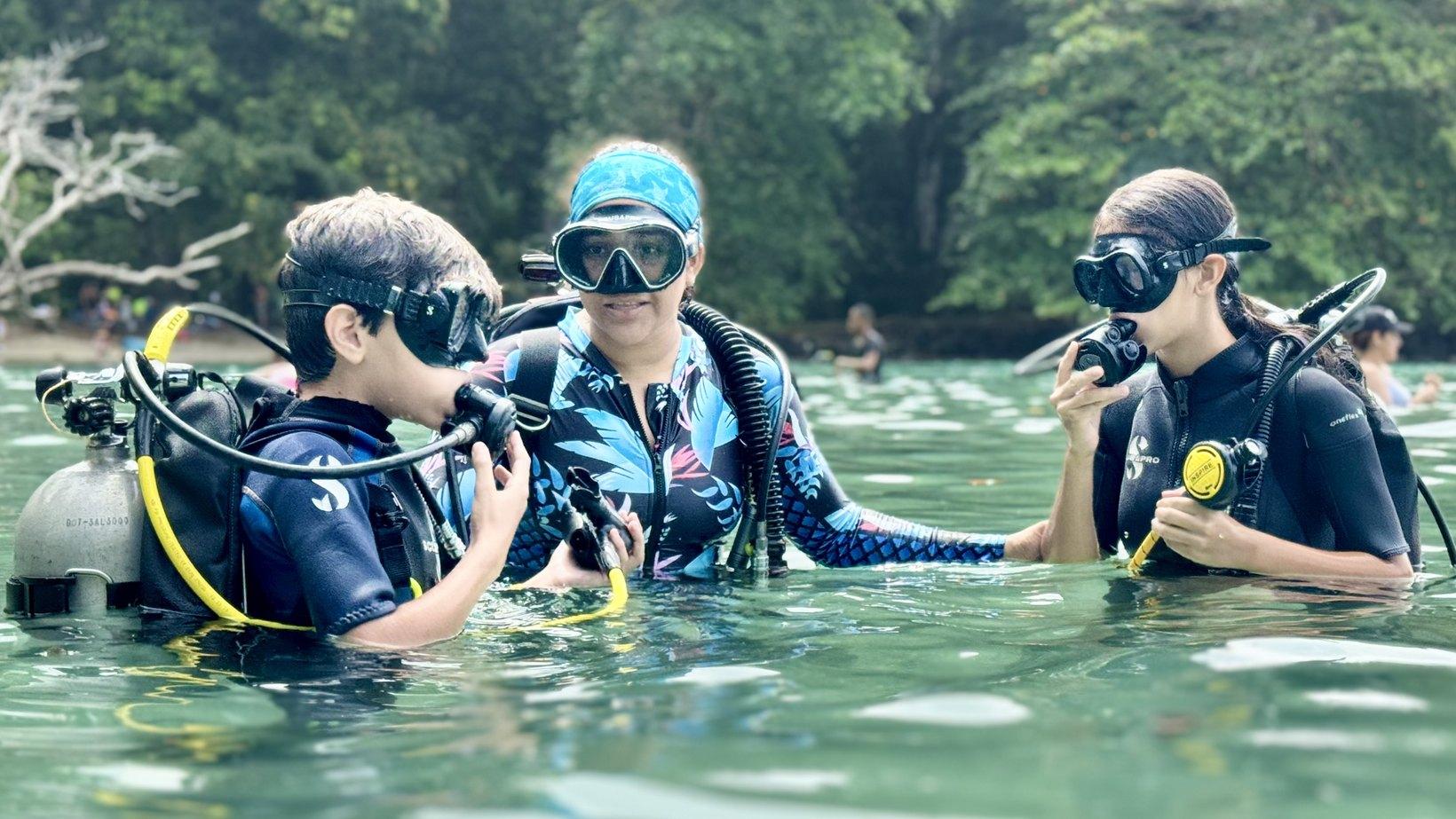
The Junior course has its own very precise rules, and when a child goes down with their parents, the parents have to learn how to dive with them too. I tell parents one thing before anything else: don't overprotect them. A lot of the time I end up playing referee, letting the child manage on their own and learn little by little. Underwater there is an instructor who knows the safety rules, and that's the person to listen to.
Here are my tips for diving with your son or daughter:
- Look after their ears. Kids get in the water so excited that they forget to equalize. Go down slowly and give them the equalize signal the whole time.
- Make sure they wear a wetsuit. A child loses heat faster than an adult.
- Make sure the gear fits them. In a big BCD that shifts around, they can't swim horizontally.
- If the backward roll off the boat scares them, put their gear on in the water.
- Keep them horizontal. One of their favorite games is popping bubbles, and that's how they go up and down without noticing.
- Hold on to them during the safety stop, the three minutes at 5 m (15 ft).
- Teach them to read their pressure gauge. When the needle reaches the red zone, the dive is over.
- No rough play. Taking off their mask or pulling out their regulator is not a game.
- Bring the camera. You have to film that experience.
Is there a maximum age for scuba diving?
No. PADI doesn't set a maximum age. What decides whether you can dive is your health, not your date of birth. I sum it up like this: you dive for as long as your body holds up, and you start when your mind says yes.
The age on your ID is one thing, physical aging is another and mental aging is another. Today people live longer and better, and they reach 50 or 60 with energy, with experience and eager to do new things. What ages you is cigarettes, alcohol, a poor diet and a sedentary life. A sedentary life kills, there's no way around it.
I've been diving since 1978. I made my first dive at 15, in Venezuela, and I promised my son that I'm going to dive until I'm 80.
Can you start scuba diving after 50 or 60?
Yes. In the 1980s I was teaching a beginner course at a club on the central coast of Venezuela, and two of my students were a grandfather of 72 or 73 and his grandson, who was about 14. The grandson carried the tanks and the grandfather was the pampered one. They made a sensational pair.
My only recommendation if you're going to start after 50: get a medical checkup first, to make sure there's no contraindication. And welcome aboard.
Diving goes well with age for three reasons:
- It's low impact on your joints and muscles. Underwater there is no pounding, the way there is in running or in contact sports.
- It adapts to each person's pace. It isn't a race: the group moves at the pace of the slowest diver.
- Slow, controlled breathing underwater helps bring stress down.
What are the medical requirements for scuba diving?
At any age, you fill out a medical statement before you dive: the official questionnaire PADI uses for all its courses. Marking a yes doesn't mean you can't dive. It means you need a doctor's approval before you get in the water.
If you're over 45, the questionnaire adds a question: whether you smoke or vape, whether you have high cholesterol or high blood pressure, or whether a close relative had heart problems before 50. If the answer is yes, you also need to see a doctor.
And on dive day, whatever your age, show up rested and with no alcohol in your system. Diving doesn't forgive a late night.
How do you stay fit for scuba diving after 40?
Diving is relaxing, but at times it asks for strength: carrying the gear, getting on and off the boat or swimming against a current, sometimes helping someone out of it. You can't get in the water out of shape. This is what I do and what I recommend:
- Exercise about four times a week, mixing cardio and strength. I train outdoors, with my own body weight: push-ups, squats, sit-ups and jogging.
- Swim. For me it's the most important exercise, because the water is our element and swimming works every muscle.
- Hydrate from the day before. I drink at least two and a half liters of water the day before a dive.
- Eat a balanced diet: protein, carbohydrates, little fat and vegetables of every color.
- Dive often. After months out of the water you lose your reflexes and the habit. My recipe is the same as always: dive, dive and dive.
Family scuba diving in Portobelo
At Panama Dive Adventure, in Portobelo, we follow the same ages as PADI: kids start at 10, with parental approval and a parent present. Discover Scuba Diving costs $120 with the gear included, and Open Water costs $540 with the eLearning theory, the certification and the gear. For certified diver trips, like Dive & Chill, we also ask for a minimum age of 10, and for the guided night dive, 12.
We head out every day at 8:00 am from the dive center and we're back around 1:00 pm. Courses have no more than six students per instructor and are taught in Spanish or in English. If someone in the family is under 10, message us on WhatsApp first and we'll talk it over.
Sources
- PADI: Discover Scuba Diving, requirements and minimum age
- PADI: Open Water Diver, requirements
- PADI: Advanced Open Water Diver, requirements
- PADI: Rescue Diver, requirements
- PADI: Divemaster, requirements
- PADI: scuba certification FAQ (minimum age and Junior)
- PADI: Discover Scuba Diving FAQs (no maximum age)
- PADI and UHMS diver medical questionnaire, in Spanish (PDF)
- My video (in Spanish): Bucea después de los 40 como si tuvieras 20
- My video (in Spanish): Introduce a tu hijo en el mundo submarino, 10 tips y beneficios
- My video (in Spanish): ¿Es el buceo recomendable para mayores de 50?
- My video (in Spanish): Por qué el buceo es el deporte ciencia