First steps
Scuba diving for beginners: the mistakes I see most often
By Álvaro Silva · · 14 min read
The mistakes I see most in beginner divers are carrying too much weight, setting up the regulator wrong, not emptying the BCD properly to go down, swimming with their hands and inflating the BCD to go up. None of them has anything to do with talent: they come from diving too little and from being too embarrassed to ask. I've been an instructor for more than 35 years, and at my center I see them regularly in newly certified divers, with four, five or six dives after their Open Water course. Here I'll walk you through them in the order they show up on a dive day. The recipe behind all of it is the same as always: dive, dive and dive.
Video in Spanish
Is scuba diving hard to learn?
Not if you learn with good habits: within a few dives you feel comfortable and stable, and your air lasts longer. The hard part is keeping up the rhythm you had when you finished the course if you dive very little afterward.
At my center I get people from many countries, and the pattern repeats. Newly certified divers, or divers who let 45 or 60 days go by without getting in the water, show up with their engines cold. What I've seen is a lack of focus, a bit of stage fright and being too embarrassed to ask: around them are divers with a lot more experience who set up their gear in no time, and the beginner feels left behind.
Diving is not a competitive sport: it's a sport of contemplation. If you have a question, ask the instructor or the divemaster. It's our job to correct you as kindly as we can, without making it embarrassing, because embarrassing someone gets you nowhere.
This table sums up what I see most, in the order of a dive day:
| Stage | The mistake | How to fix it |
|---|---|---|
| Before you arrive | Not knowing what gear you have or how much weight you use | Tell the center what you're bringing, what you're renting and your sizes, and keep a logbook |
| Setting up the gear | Mounting the regulator backward and skipping the buddy check | Set up without rushing, ask someone to check it and do the full buddy check |
| Choosing your weights | Asking for extra weight to make sure you go down | Do a buoyancy check before the dive |
| Going down | Not raising the inflator hose and fighting the BCD | Inflator held high, breathe out and go down upright, equalizing |
| On the bottom | Swimming with your hands, drifting away from your buddy and not looking at your instruments | Hands still, the same depth as your buddy and frequent glances at your pressure gauge |
| Going up | Inflating the BCD to go up and skipping the safety stop | Empty the BCD, go up slowly using your legs and do the stop |
What should you do before scuba diving?
Before you dive, be clear about three things: what gear you have, what connection your regulator uses and how much weight you used last time.
It sounds obvious, but it isn't. When people book with me on WhatsApp or by email, many tell me: I have my own dive gear. They get to the center with a mask, snorkel and fins. What about the regulator, the BCD, the computer? Oh, I didn't know. No problem, you just rent it, but it happens with about half the people.
Mask, snorkel and fins are the basic gear. The scuba gear is the BCD, the full regulator with its octopus and its pressure gauge, the wetsuit and the computer. When you write to a dive center, say what you're bringing, what you need to rent and in which sizes.
The same goes for the regulator connection. There are two: yoke, which clamps over the tank valve, and DIN, which screws into it. A diver who showed up armed to the teeth couldn't tell us which one was his. He asked for a DIN tank, mounted a yoke regulator on it and, when he opened the valve, there was a massive leak. Álvaro, this tank is faulty, he told me. Relax, don't worry, I answered: you asked for a DIN tank and you have a yoke regulator.
And write it down. After every dive, note in your logbook how much weight you used and which suit you wore.
How do you set up your scuba gear correctly?
The regulator's air inlet has to line up with the air outlet on the tank valve. The mistake I see most during setup is a regulator mounted backward.
A standard valve has the air outlet on one side and, on the back, a small dimple where the yoke screw rests. Someone who doesn't look carefully puts the regulator's inlet against that dimple. Since the screw seats there just the same, everything looks normal until they open the valve and get a massive leak. Mounted correctly, the regulator hose comes over your right shoulder.
And don't show up with your gear all loose either: the regulator hanging from your neck, the mask in one hand and the fins in the other. Carry it all together and protected. A plastic crate like the ones farmers use, sturdy and cheap, is an excellent way to do it.
If it's your first dive trip after the course, don't be embarrassed: ask the divemaster to check how you set it up. And on a day with several dives, it's a good idea for the divemaster to supervise the second setup too, until the diver feels confident.
With the gear ready comes the buddy check, and very few people do the whole thing. The check PADI teaches has five steps, known by the initials BWRAF. This is how I go through it:
- BCD: the tank band holds the tank firmly, it inflates and it doesn't lose air.
- Weights: the amount your logbook says, if you're in the same conditions as last time.
- Releases: every buckle closed, none with a broken tooth, and the straps adjusted to your size.
- Air: a full tank, and a regulator that gives you air easily and with no bad smell.
- Final OK: both of you ready, and into the water.
How much weight do I need for scuba diving?
The least you can still go down with. And you don't guess it: you confirm it with a buoyancy check before the dive.
People ask me for amounts of weight I sometimes can't believe. Once, a slim diver in a lycra dive skin asked me for 16 pounds. I told him: wait, trust me, let's do a check first. He went down slowly, without having to use his BCD, and when he came out he told me: I just broke my dive record. It was 55 minutes. They loaded me up with weight to keep me kneeling on the bottom, he told me, and that's how I've dived my whole life.
The check is simple. With all your gear on, a full tank and an empty BCD, you take a breath and you should float with the water at eye level. When you breathe out, you start to sink. Ask for it at any dive center, especially if you come from cold water: here, with warm water and a thin wetsuit, you use a fraction of the weight you wear at home with a thick suit.
Why does it matter so much? Because the air in your tank is for you to breathe, not to give away to your BCD. An overweighted diver spends the dive inflating and deflating, and their dive is shorter. At the end, as they go up, the air they put into the BCD expands, the gear carries them to the surface and they miss the safety stop. Back on the boat, it's always the same line: oh, I don't know what happened to me today.
It's been ages since I put a student on the bottom loaded with lead and kneeling: a diver who starts like that never has neutral buoyancy from the beginning. I learned to dive in the 1970s, when they didn't give us a BCD, and starting out with neutral buoyancy was the norm.
Why can't I descend at the start of a dive?
Almost always, because you didn't raise the inflator hose properly and the BCD didn't empty.
It's the first mistake I see once we're in the water, and I see it in a high percentage of divers. When the divemaster says empty your BCDs, they leave the inflator at shoulder or chest height. The hose bends, the air gets trapped and they don't go down. They think they can't, they flip head down, they start fighting it and they begin the dive tired and anxious.
If it happens to you, don't fight it: the divemaster comes over, calms you down, empties your BCD and controls your descent. And next time, do it in this order:
- At the surface, finish inflating your BCD and float calmly, without using the air in your tank.
- When they give the signal, put the regulator in your mouth and don't take it out again.
- Raise your arm with the inflator held high, so the hose is straight, and empty the BCD.
- Empty your lungs and go down upright, slowly.
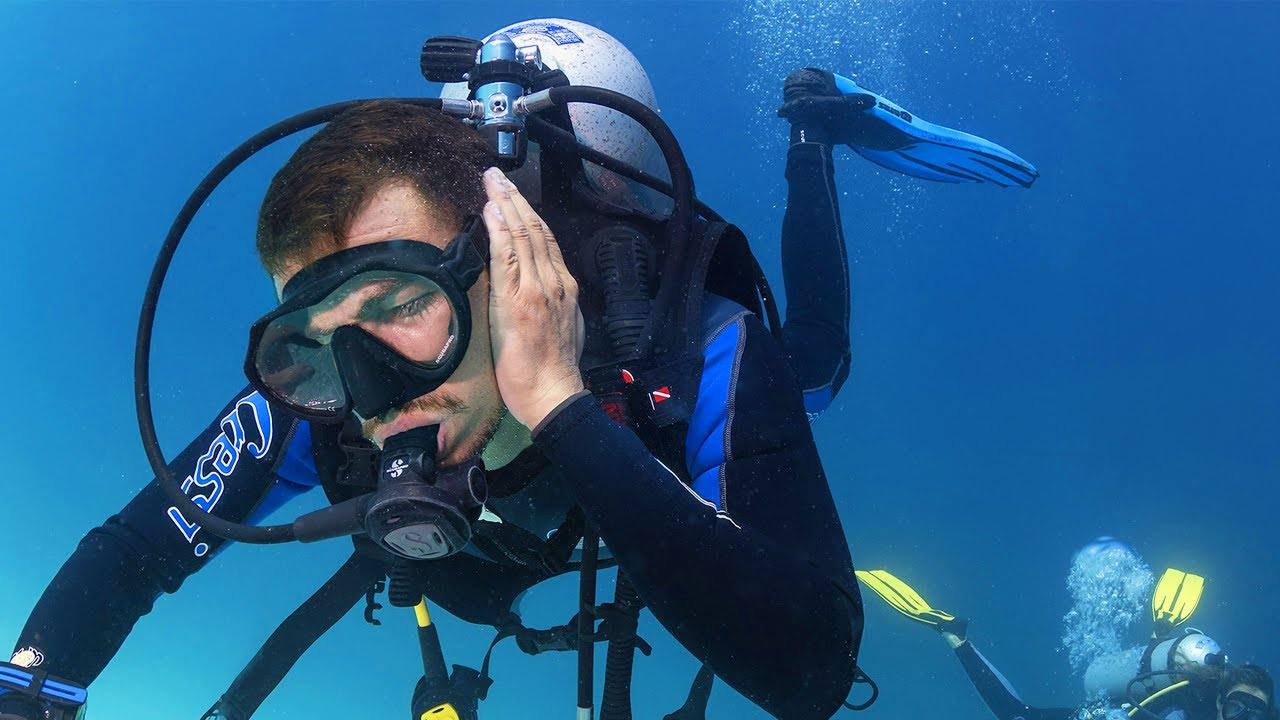
- Equalize your ears from the moment you go under, and very often, without waiting for them to hurt. PADI says the same: early and often.
- When you reach the bottom, don't start swimming right away. Give yourself a few seconds to get your bearings, get horizontal and find your buoyancy.
How do you swim while scuba diving?
With your legs, in a horizontal position and with your hands still.
When a diver isn't carrying the right weight, they turn to their hands. They look like little dogs paddling, or they think they're mermaids. You don't use your hands. Keep them in front of you, crossed or at your waist: you spend less energy, use less air and your dive lasts longer. Your hands are for your instruments: the compass goes on the left, the computer on the right and the pressure gauge down below.
The second mistake on the bottom is diving far from the reef and from your buddy, as if the reef would bite. The reef doesn't bite. The right way is to stay at the same depth, side by side or one behind the other, always knowing where each of you is. Nobody has eyes in the back of their head.
And the third is trusting the guide too much. The line I hear all the time is: no worries, Álvaro, I'll follow you. Thanks for the vote of confidence, but that's not the idea. If you only follow me, you don't learn to use a compass or to navigate by natural landmarks. Pay attention to the route you take, the heading you're on and which way the exit is.
What should you check on your dive computer and pressure gauge?
On the computer, three things: depth, time and the no-decompression limit. On the pressure gauge, how much air you have left and which unit you're reading it in.
A lot of people buy a computer and don't know how to use it. The dive plan sets a maximum depth and a time, and you don't go over either one. The no-decompression limit is that countdown that keeps getting closer to zero: when you come up a little, it climbs again and you gain minutes. If you don't know your screen well, ask your instructor for help and read the manual, even if it's a bit of a pain.
With the pressure gauge, the mix-up is the unit. My center works in bar. I hand out the gear and suddenly I hear a little voice: they didn't fill this tank right, it has 2000 psi. I go over. The gauge is in bar and reads 200, which is a full tank. In psi, that same full tank reads 3000.
My advice works with any unit: divide your tank into three parts. See how long it takes you to use the first third, and use that to estimate the rest of the dive. When you get into the last third, you start going up: with a 210 bar tank, at 70, and with a 3000 psi tank, at 1000. That's the rule I use, and it matches the rule of thirds PADI recommends.
How do you ascend and when should you do a safety stop?
Before you go up, empty your BCD, and go up slowly, using your legs. You do the safety stop at the end of every dive.
The mistake is the opposite: it's time to go up and some divers hit the inflator and shoot up like a rocket. They forget that the air in the BCD expands as they rise and that the tank, with little air left, floats more. With an empty BCD and a gentle kick, you go up, stay neutral at the stop and finish a perfect dive.
According to PADI, your ascent rate shouldn't go over 18 m (60 ft) per minute, and the safety stop lasts at least 3 minutes at 5 m (15 ft). I tell my students never, ever to skip it and to use it to check on themselves: Am I tired? How's my breathing? Does my heart feel normal? If those minutes weren't enough, stay a little longer and go up when you feel calm.
When you finish the stop, don't shoot up. When I got into technical diving, between 1999 and 2000, I brought back to recreational diving a rule I thought was wonderful: I go up the last stretch to the surface even more slowly, because that's where the most drastic volume changes are. At the surface, you inflate your BCD, and only with your head completely out of the water do you take the regulator out.
Scuba diving for beginners in Portobelo
At Panama Dive Adventure, in Portobelo, these mistakes get fixed with a good course and by diving often. If you're not certified yet, the Open Water course costs $540 and includes the PADI eLearning theory, the certification and the gear. You pay in two parts: $230 for the theory and $310 the day before the practical training. It takes 3 to 4 days, with four open water dives and no more than six students per instructor, in Spanish or in English.
With Open Water, as an adult, you're trained to dive to 18 m (60 ft). If a more experienced group invites you to go deeper, learn to say no: that's what Advanced is for, and it prepares you to go down to 30 m (100 ft) if you're 15 or older.
If you're already a diver and your engines are cold, Dive & Chill costs $110, and gear rental is $45 a day. We head out every day at 8:00 am from the dive center and we're back around 1:00 pm. Message us on WhatsApp and tell us what gear you have, what you need to rent and when your last dive was: we do the buoyancy check before going down.
Sources
- PADI: the golden rules of scuba diving (18 m (60 ft) per minute, safety stop and rule of thirds)
- PADI: how to ascend and descend safely (18 m (60 ft) per minute and safety stop)
- PADI: the pre-dive buddy check (BWRAF)
- PADI: ear equalization and ear care for scuba divers
- PADI: Advanced Open Water Diver (the 18 m (60 ft) limit of Open Water and down to 30 m (100 ft))
- PADI: Open Water Diver, requirements
- My video (in Spanish): 3 errores comunes que cometen los buzos novatos
- My video (in Spanish): 5 errores que probablemente estás haciendo
- My video (in Spanish): 3 errores que muestran que eres un buzo novato
- My video (in Spanish): 6 errores que la mayoría de buzos cometen
- My video (in Spanish): Los 5 errores que te ponen en peligro bajo el agua
- My video (in Spanish): 3 horribles hábitos en cursos de buceo