Skills
Advanced Open Water: what it is, requirements, when to do it
By Álvaro Silva · · 11 min read
On paper, an advanced diver is anyone who finished the Advanced Open Water course: five more dives after Open Water, with the deep dive and navigation required. But that card doesn't make you a true advanced diver. If you take the two courses back to back, you finish with nine dives, and that's a very long way from the real thing. I say this after more than 35 years as an instructor and more than 5,500 people certified: a true advanced diver is made underwater, with many dives in different settings. And there's only one recipe for that: dive, dive and dive.
Video in Spanish
What is the Advanced Open Water Diver course?
It's the course that comes after Open Water: five adventure dives with an instructor, two required and three you choose. The required ones are the deep dive and underwater navigation.
The other three depend on the place and on what interests you most: night diving, buoyancy, nitrox, photography or marine life, among others. Each one is a taste of a specialty, and if you later want to get certified in that specialty, the dive can count toward it. You study the theory online with PADI eLearning, in about 6 to 8 hours, and the whole course takes 2 to 3 days.
For me it's a really fun course. The only thing I'm not sold on is the name, and I'll tell you why.
What makes a true advanced diver?
A true advanced diver is someone with many dives, in many different environments, who has mastered what they do. It's not someone who finished a second course and got a title that says advanced.
Do the math. Open Water has four open water dives and Advanced adds five. If you take one right after the other, you finish with nine. That's fine to start with, but there's a whole universe between the Advanced course and a true advanced diver.
To me, a true advanced diver looks a lot like a Master Scuba Diver, the highest level in PADI recreational diving: someone already certified in Open Water, Advanced and Rescue, with five specialties and at least 50 logged dives. I call it the black belt of recreational diving. These are the things that set them apart:
- They've dived in different environments: from a boat and from the beach, in a lake, in cold water, at night, in poor visibility.
- They never leave the compass on shore. It goes on their wrist or on their console, and they know how to use it.
- They think like a Rescue Diver. When they plan, prevention comes first, so a chain of errors never gets started.
- They've mastered the theory. Every week people ask me: Álvaro, can I rinse my regulator without the dust cap so it gets clean inside? The cap is there to keep water out. Theory keeps you away from accidents.
- They dive often. My ideal average, and this is a personal opinion, is 40 to 50 dives a year at the very least.
What are the Advanced Open Water Diver requirements?
You need the Open Water certification, or Junior Open Water, and you have to be at least 12 years old. PADI doesn't ask for a minimum number of dives: you can go straight from Open Water to Advanced.
From 12 to 14 the certification is called Junior Advanced Open Water, and at 15 it becomes Advanced Open Water without repeating anything. If you're a minor, your dad, your mom or your guardian signs the medical statement.
Before getting in the water, everyone fills out the medical statement. A yes doesn't mean you can't dive: it means you need a doctor's approval.
What dives are in the Advanced Open Water course?
It has five adventure dives: the deep dive and navigation, which are required, and three you choose depending on where you take the course.
The order matters a lot. I never do the deep dive first: someone who has made four dives no deeper than 18 m (60 ft) has no reason to go down to 30 m (100 ft) on the first dive of the course. For me it's the fourth. On day one I start with a self-rescue review, which gives you a lot of confidence in the water. Then comes buoyancy and, weather permitting, I finish with a night dive. At night the sea is just as calm as during the day: they just turned off the lights, and your flashlight becomes your cane.
On day two, with your engines nicely warmed up, we go for the deep dive, and navigation comes last, in a flat area 6 to 8 m (20 to 26 ft) deep, so you don't keep adding nitrogen. With few reference points on the bottom, you have to trust the compass.
I prefer to teach search and recovery as a full specialty, so you become a good searcher. These are the two required dives and the optional ones we do in Portobelo:
| Dive | In the course | What you practice |
|---|---|---|
| Deep dive | Required | Going below 18 m (60 ft), to 30 m (100 ft) at most if you're 15 or older |
| Underwater navigation | Required | Compass work, patterns like the square and the triangle, and measuring distance in kick cycles |
| Buoyancy | Your choice | Getting your weighting right and swimming steady, without going up and down |
| Night dive | Your choice | Diving with a flashlight and seeing the life that comes out at night |
| Nitrox | Your choice | Diving with enriched air, which extends your no-decompression limits |
| Naturalist | Your choice | Identifying fish, corals and other reef animals |
| Underwater photography | Your choice | Taking photos and video without losing your buoyancy |
How deep can you dive with Advanced Open Water?
With Advanced you're trained to go down to 30 m (100 ft) if you're 15 or older. With Open Water, the limit is 18 m (60 ft).
To PADI, any dive below 18 m (60 ft) already counts as a deep dive. The one in your course may be shallower than 30 m (100 ft): it depends on your age, on the local rules and on how deep the site is.
If you want to go deeper later, there's the Deep Diver specialty, which requires you to be 15 and prepares you to go down to 40 m (130 ft), the limit of recreational diving. It's a specialty I love. My advice: take it with nitrox, so you get more out of your no-decompression limits.
How many dives do you need before Advanced Open Water?
As far as PADI is concerned, none: you can take it right after Open Water. I recommend diving before you take it, and how many times depends on how comfortable you feel in the water.
Very different people come to Open Water: the swimmer who trains every day, the kid who grew up in the river catching shrimp on a breath-hold, and the person who has been afraid of the water all their life. All three finish with four dives, but they aren't equally comfortable.
Not long ago I changed my view a little. Some groups come on vacation and buy Open Water and Advanced together. If the Advanced is well run, those nine dives plant the seed for that person to fall in love with diving and not give it up. I'd call it an Open Water plus. Mind you: it's still nine dives.
People ask me: Álvaro, can I take the advanced course with 12 dives? In my step-by-step guide I recommend between 15 and 20, but the answer is yours to give, together with your instructor, who's the one who saw you in the water. Ask yourself these questions:
- Do I feel comfortable in the water and with my gear?
- Do I clear my mask easily and without stress? Can I go without my mask and breathe calmly from the regulator? If taking your mask off terrifies you, my answer is no: we keep diving and polishing that skill until you get past it.
- Does the way I swim let me move around easily?
- Did I come out of Open Water with good neutral buoyancy? Without it, the photos and videos from the course are going to be a disaster.
What comes after Advanced Open Water?
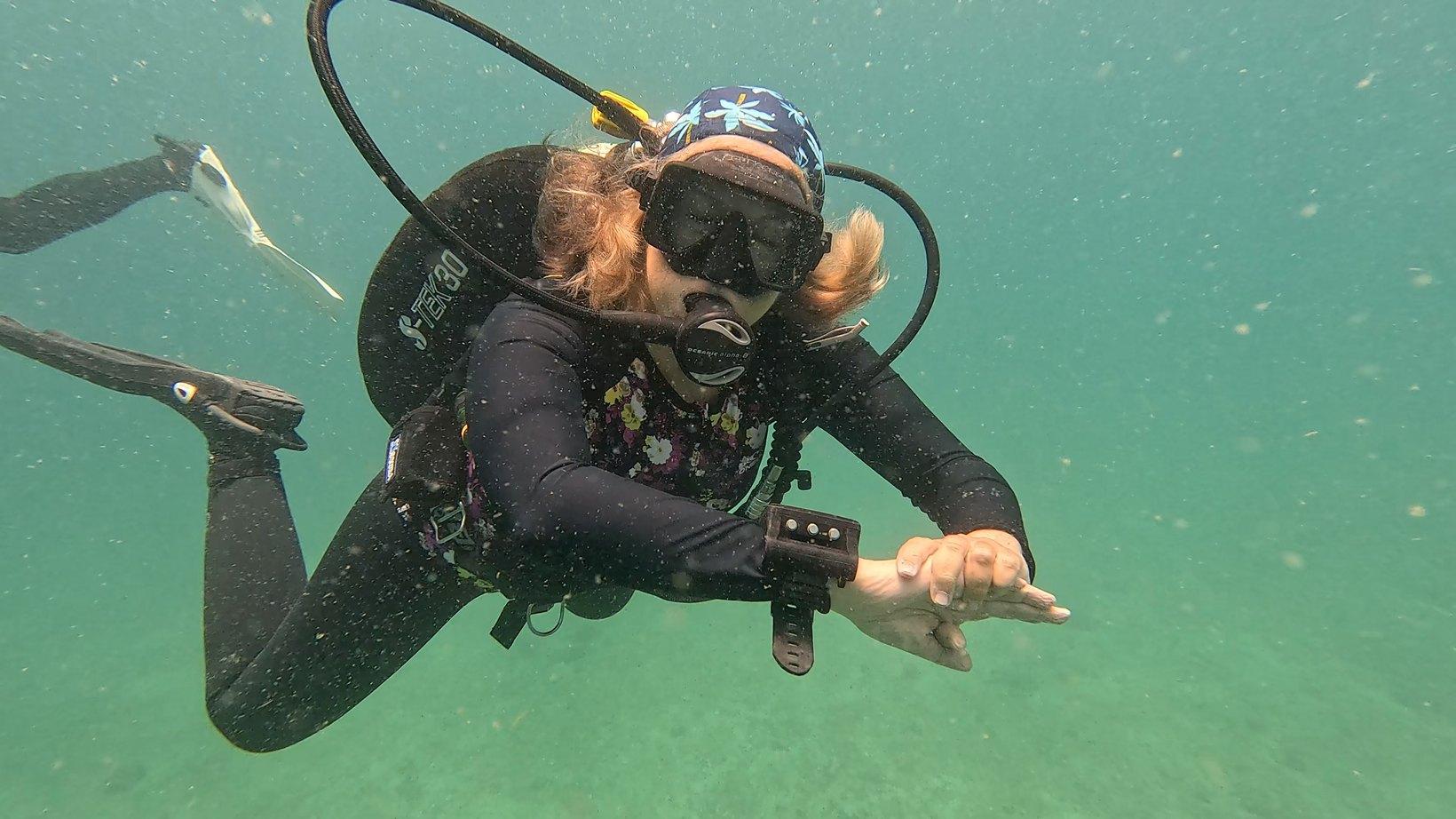
Keep diving, and now in more challenging settings. It's the only way to turn the card into experience.
When the sea is flat as a mirror, the diving is unforgettable, but if you only dive on perfect days, you don't grow. In poor visibility, trust the compass and go from point A to point B. Dive at night more often. And if you end up on a small boat with no ladder, learn to take your gear off at the surface and pull yourself up with the strength of your arms.
Then comes the course that makes a diver grow the most: Rescue Diver. Many people say it's the most challenging and at the same time the most fun, and it changes your mindset: you become a cautious diver. It requires first aid and CPR training within the last 24 months, and PADI recommends showing up with at least 20 dives. I ask for more: between Advanced and Rescue, no fewer than 30, and good physical condition, because you're going to have to tow a victim.
A warning: if you take the course and then go a year or two without diving, all that work is lost, because the reflexes fade. PADI recommends not going long stretches without diving and, if you have, doing a refresher first. And these are the mistakes I see most in experienced divers:
- Rushing the gear setup. An advanced diver sets up calmly, and the less experienced divers are watching.
- Letting the octopus and the pressure gauge dangle until you look like a Christmas tree. If an emergency comes up, the octopus has to be where it belongs.
- Doing only half a dive plan. Maximum depth, time, air, entry and exit points, and the lost buddy procedure: you talk through all of it before getting in.
- Sharing air to keep diving. The alternate air source is for going up, never for stretching the dive.
- Not practicing the basics anymore. In a refresher I asked a diver with years of experience when he had done his last controlled emergency swimming ascent, and he told me never.
Advanced Open Water in Portobelo
At Panama Dive Adventure, in Portobelo, the Advanced Open Water course costs $540 and includes the theory on PADI eLearning. You pay in two parts: $230 for the theory and $310 the day before the in-water training. We send you the theory code ourselves when you book. It's five dives over 2 or 3 days, with a maximum of six students per instructor, in Spanish or in English. Gear is separate: bring your own, or rent it for $45 a day.
We go out every day at 8:00 am from the dive center and come back around 1:00 pm. If you come on your own, we'll expect you at 8:30. If you'd rather have us pick you up at your hotel, the transfer is $180 round trip per group. And if you want to add Nitrox, which to me is the traveler's tool, it costs $330, plus $232 for the theory.
Not sure if you're ready yet? Message us on WhatsApp, tell us how many dives you have and we'll talk it over.
Sources
- PADI: Advanced Open Water Diver, requirements, dives and depth
- PADI: Deep Diver, minimum age and maximum depth
- PADI: Rescue Diver, requirements and recommended dives
- PADI and UHMS diver medical questionnaire, in Spanish (PDF)
- My video (in Spanish): Una nueva visión del curso AOWD
- My video (in Spanish): ¿Cuándo deberías hacer tu curso avanzado y de rescate?
- My video (in Spanish): 5 tips para buzos Advanced Open Water Diver
- My video (in Spanish): 3 consejos para buzos avanzados
- My video (in Spanish): 4 errores que cometen los buzos avanzados