Skills
Divemaster: what it is, requirements and course cost
By Álvaro Silva · · 10 min read
Becoming a divemaster is your first professional step in diving: you guide certified divers and help the instructor on their courses. To start the PADI course you need to be 18 and have your Rescue Diver certification, up-to-date first aid training and 40 logged dives. At my center it costs $1,833: $1,500 for the practical part and $333 for the theory. I've been an instructor for more than 35 years, and I've certified divemasters from Panama, Mexico and Venezuela. A subscriber wrote to me from Curaçao: Álvaro, there are a lot of videos saying it isn't worth it. I think the opposite, and here's why.
Video in Spanish
What is a divemaster?
Divemaster is PADI's first professional level: a dive leader who guides certified divers and helps instructors with their courses.
Nothing makes an instructor's job easier than a divemaster they can trust with their eyes closed. For me, mask clearing is the number one skill in Open Water: for some people, the moment water touches their nose, they're terrified. With me, nobody touches salt water until they can clear their mask. A divemaster with the magic touch to help that student is the assistant every instructor needs.
According to PADI, this is what you can do as a certified divemaster:
- Assist a PADI instructor on courses and dive outings.
- Guide certified divers on dive trips.
- Lead the Discover Local Diving program, showing your area to divers who don't know it.
- Assist on Discover Scuba Diving, the first experience for someone who has never dived.
- Give the ReActivate refresher to divers who haven't dived in a while.
- Teach the Discover Snorkeling and Advanced Snorkeler courses, and organize conservation activities.
Is divemaster worth it?
Yes, if you like guiding and helping other divers, and also if you just want to dive better. If you don't want to lead or become an instructor, you don't have to take it, but even so, the theory adds a lot to any diver. PADI says the same: many people take the course just because they love diving and want to get better.
The course is ideal for divers with the makings of a leader: people who communicate easily, are charismatic and organized, feel comfortable underwater and like helping others.
A very close friend of mine with three daughters used to tell me: Álvaro, this diving is getting really expensive, and it all comes out of one pocket. I had already taught his daughters to dive, so I told him: become a divemaster. Wherever you go with them, you're the divemaster, and I'll provide the boat. He took the course, loved it, and it sharpened his protective eye as a dad. Now diving isn't so expensive for him anymore.
When I taught at Simón Bolívar University in Venezuela, the scuba club ran its own trips, without instructors, and its own divemasters led them.
What are the divemaster requirements?
To start the PADI divemaster course you need to be 18 and have your Rescue Diver certification, up-to-date first aid training, 40 logged dives and a doctor's clearance.
The path goes like this: Open Water, then Advanced, then Rescue with its first aid course, and then you move on to divemaster. Here's a detail that confuses a lot of people: the 40 dives are what you need to start the course, not to finish it. To get certified you need at least 60. These are the requirements PADI publishes:
| Requirement | What PADI asks for |
|---|---|
| Minimum age | 18 years |
| Prior certification | Rescue Diver, or an equivalent certification |
| First aid and CPR | Emergency First Response Primary and Secondary Care, or equivalent, within the last 24 months |
| Dives to start | 40 recorded in your logbook |
| Dives to get certified | At least 60 |
| Health | Evaluation and clearance by a physician within the last 12 months |
| Gear | A full set of dive gear |
| Theory | PADI eLearning, 10 to 16 hours |
How long does the divemaster course take?
At my center it takes three weeks: an intensive internship, diving every day, with 36 to 40 dives. According to PADI, you can do it in two very intense weeks, and most people finish in three weeks to six months.
You do the theory online before you come, with PADI eLearning. In Portobelo I back it up with reviews and written exams, and the rest of the time you're in the water. Diving every day, your skills come along incredibly fast, and since I repeat the safety protocols over and over, they become your own.
My advice before you sign up: come with the Deep Diver, Underwater Navigator and Search and Recovery specialties, or with a lot of experience in those three areas, because the course makes you go over them again. I also can't picture a divemaster without the Night Diver specialty. In my years teaching the course, most people show up with 50 to 60 dives.
What is the divemaster course like?
It's demanding: lots of time in the water, fitness tests, evaluations and assisting on real courses.
On the first day we do two check dives to look at each person's air consumption, buoyancy and gear. Then we go over the Open Water skills again, but now it's not enough to take off your mask and clear it: you have to do it as a demonstration, slow and clear, so a student can follow it.
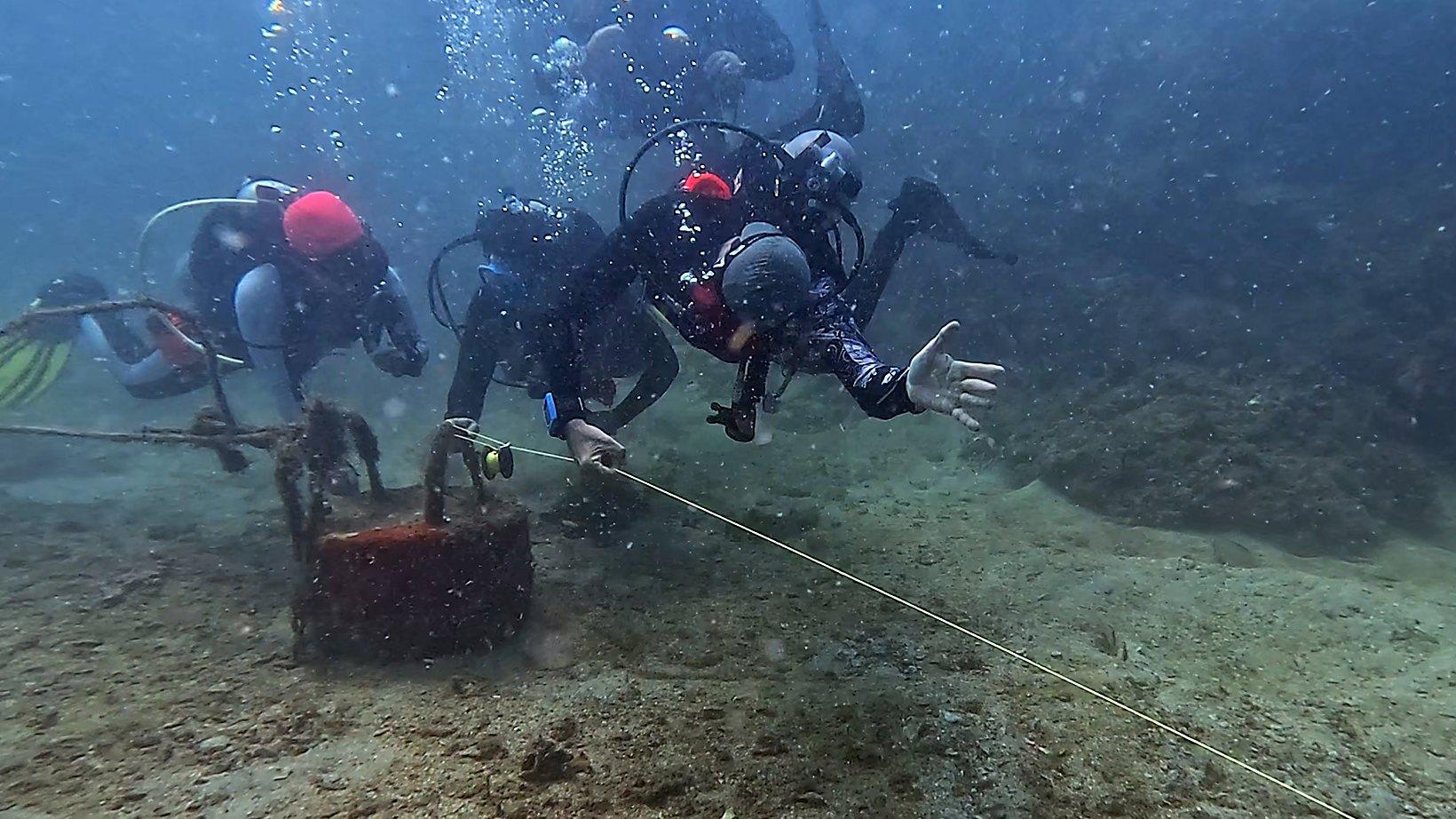
Next come the evaluations in deep diving, navigation and search and recovery. On one search we had a real case: a mask got lost and we set up search patterns to find it. Along the way, one student found another mask, a weight belt with weights and a GoPro on the bottom.
Then comes the rescue evaluation, from A to Z, and the most valuable part: assisting on real Discover Scuba Diving and Open Water courses. We practiced it first with simulations, and everyone said the same thing: the simulation was nothing like the real thing.
We follow PADI's swim tests to the letter. After the first long swim, my students realize that becoming a divemaster is no joke:
- Swim 400 meters nonstop, with no swim aids, in any stroke you like.
- Swim 800 meters face down, nonstop, with only a mask, snorkel and fins, without using your arms.
- Tow or push another diver 100 meters on the surface, nonstop, both of you in full gear.
- Stay afloat for 15 minutes with no aids, in just a swimsuit, with your hands out of the water for the last two minutes.
What do you learn in the divemaster course?
You learn to guide a group, assist the instructor and manage safety, and along the way you become a much more well-rounded diver.
The theory covers the divemaster's role, risk management, the environment, physics, physiology and dive planning, and there's a pretty tough exam. You learn to give dive briefings and debriefings and to map a dive site. And you get to know the PADI Encyclopedia of Recreational Diving, a book I recommend to any diver.
These are the five things I see my students get better at by the end of the course:
- Navigation. You dive the same sites so many times that you end up with the map in your head. I tell my students that the reef talks and tells you which way to go.
- Buoyancy. We correct your trim and your finning until you're an example for others to follow. There is only one recipe: dive, dive and dive.
- Air consumption. With good buoyancy, good finning and confidence, your air consumption drops on its own.
- Theory. You understand the laws of physics, you recognize the symptoms of each type of accident and you know how a regulator works inside.
- Safety. You never skip a protocol, and you know how every diver in the group is set up, from the long hose to the smallest detail of their configuration.
What makes a good divemaster?
A good divemaster communicates well, is organized, is a good sailor, has perfect buoyancy and is honest about what they promise.
When divemasters come to me looking for work, the biggest problem I run into is communication: some say very little and others say too much, and too much comes across as arrogance. I haven't been able to hire those.
On the boat, the captain is the top authority. And you have to be a sailor: know how to drop the anchor and be comfortable sharing the boat. A divemaster who gets seasick the moment they take their eyes off the horizon just doesn't work. This is what I ask of a divemaster:
- Presentable gear. A torn wetsuit or a patched-up mask is not acceptable. The customer thinks: if this is how they keep their gear, I can't imagine how they handle everything else.
- Perfect buoyancy, and I mean perfect: with your breathing and the right weighting, not by adding air to your BCD all the time.
- Check all the gear at least twice. At the center everything can be fixed, at sea not so much.
- Know how to run the compressor and speak English, even if it isn't perfect.
- Know the marine life in your area. As a divemaster, it's your duty to research it.
- Never promise what you can't deliver. If the site has no big animals, don't even mention them.
Divemaster vs instructor: what's the difference?
A divemaster guides certified divers and assists the instructor, and the instructor is the one who teaches dive courses and certifies students.
That's why it worries me to see divemasters teaching courses without the instructor knowing. Don't get drawn into that: if you're going to teach, do it under an instructor's direct supervision.
If you dream of becoming an instructor, divemaster comes first: you can't get there without it. After that come the PADI instructor course, the IDC, and the instructor exam. One of the graduates of my first international course had been diving with me since he was 10, and he came out of the course working by my side, on his way to becoming an instructor.
The divemaster course in Portobelo
At Panama Dive Adventure, in Portobelo, the divemaster course costs $1,833 per person: $1,500 for the practical part and $333 for the theory in PADI eLearning. You pay for the theory with your booking and I send you your code, so you don't have to buy anything on padi.com. It's a three-week internship with 36 to 40 dives, and you need your own full set of gear in perfect condition.
We leave the center every day at 8:00 am and are back around 1:00 pm. There are no more than six students per instructor, in Spanish or English. The divemaster course is booked by WhatsApp: message me and we'll set the dates. And if you still need Rescue Diver, start there: it costs $540, with the theory included.
Sources
- PADI: Divemaster, requirements, swim tests and frequently asked questions
- PADI: Rescue Diver, requirements
- PADI: Emergency First Response Primary and Secondary Care, first aid and CPR
- My video (in Spanish): Los 10 Mejores Consejos Para Ser el Divemaster Más Querido
- My video (in Spanish): 12 Tips para Divemasters: Consigue tu trabajo soñado
- My video (in Spanish): 5 Cosas que SOLO Aprendes Haciendo el Curso de Dive Master
- My video (in Spanish): La Realidad De Hacer El Curso De DiveMaster Internacional
- My video (in Spanish): Así Se Ve El Curso de Divemaster Internacional
- My video (in Spanish): Solo los mejores Dive Masters dominan esto…