Safety
What to do if you run out of air scuba diving
By Álvaro Silva · · 12 min read
If you run out of air underwater, you have two ways out: breathe from your buddy's alternate air source or make a controlled emergency swimming ascent. You learn both in the PADI Open Water course. But I'll tell you something I've been repeating for more than 35 years as an instructor: running out of air is not normal, and it should never happen. It almost always comes from poor air management, from a check somebody skipped or from overconfidence. Here I'll tell you what to do if it happens to you and, above all, how to keep it from happening.
Video in Spanish
What happens if you run out of air underwater?
You have two ways out, and you learn both in the Open Water course. If your buddy is close, you breathe from their alternate air source, the octopus. If the surface is closer than your buddy, you make a controlled emergency swimming ascent.
For a lot of divers, this question is terrifying. I don't see it that way: if you had a good course, you have the tools. What I find crazy are the videos that treat running out of air as an everyday thing. It is not a normal situation, but you have to be ready for it.
This table sums up what to do in each case:
| Situation | What you do | What matters most |
|---|---|---|
| You run out of air and your buddy is close | You give them the out-of-air signal and breathe from their alternate air source | You go up together, slowly; the dive ends right there |
| You run out of air and the surface is closer than your buddy | Controlled emergency swimming ascent | Looking up and exhaling the whole time |
| Your buddy runs out of air | You give them your alternate air source and show them your pressure gauge | You steady them and you go up together |
Why do scuba divers run out of air?
In most cases, because of poor air management: the diver didn't check the pressure gauge because they were too caught up in the dive. It also happens through a slip in the pre-dive check, like a valve that wasn't opened all the way, or through overconfidence, which is the one trap you must never fall into. Even the most experienced divers can run out of air if they skip a step.
Equipment failures do happen, but they are less common. On my boat, an experienced tourist had his high-pressure hose come off the fitting. Luckily it happened up top, on the boat. We closed the valve in time, gave him the spare regulator we always carry, and he went on diving: out of 210 bar, the tank lost only about 5 to 10.
Another time, on a shore dive, I saw people leave their gear set up in the sun for three or four hours while they chatted. Heat softens the hoses, and when the valve was opened all at once, the low-pressure hose burst. We had a spare with us, and the dive went ahead.
And then there is the stuck pressure gauge. A diver came over to me signaling: the needle on his gauge hadn't moved for a while. I gave the gauge a knock and the needle dropped to 30 bar. That was enough to do his safety stop calmly, and we got out with no trouble. The good thing was that he didn't trust it. If the needle hasn't moved in about five minutes, give it a little tap and let your buddy know.
How do you share air with an alternate air source?
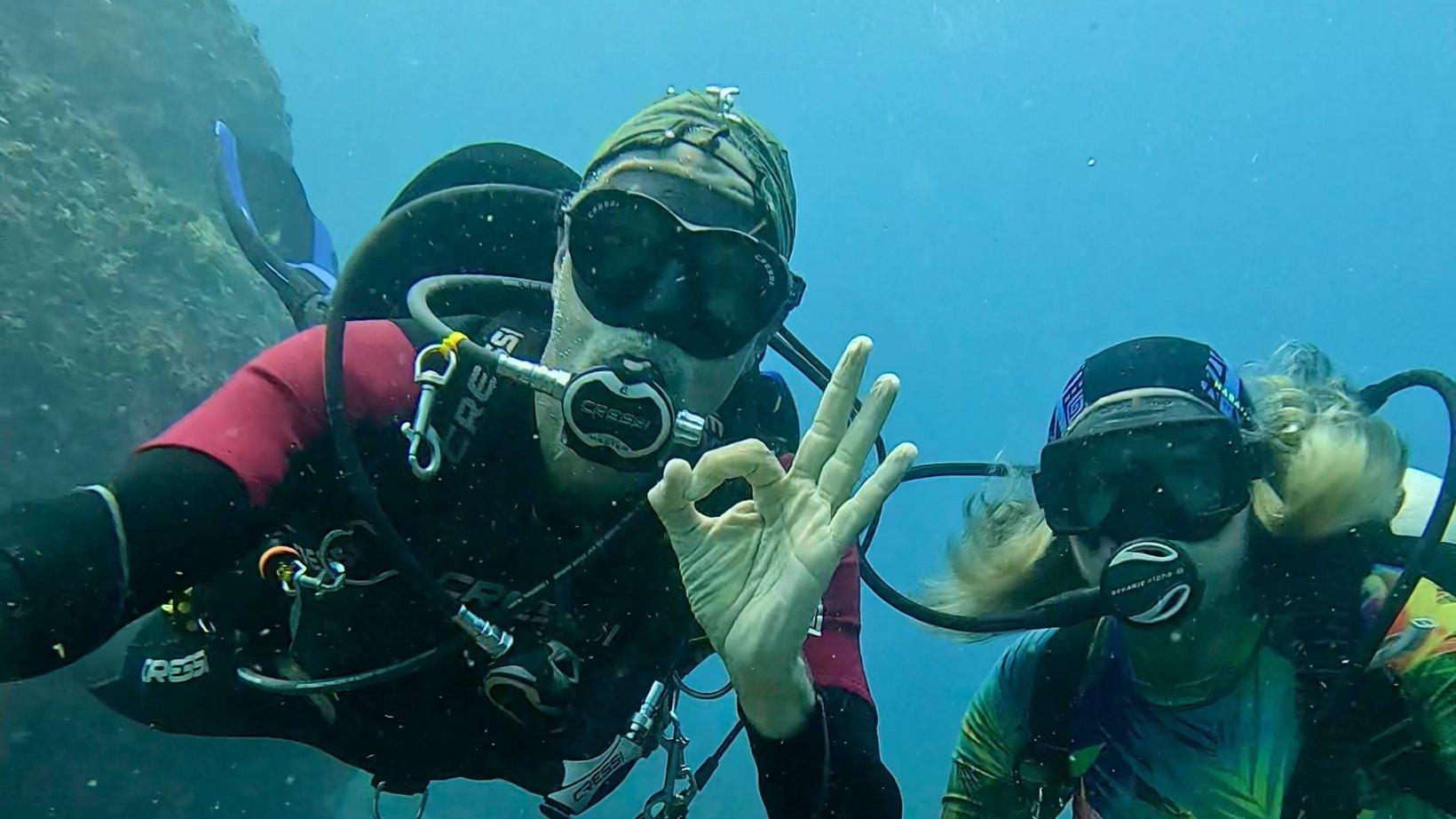
You give your buddy the out-of-air signal, they hand you their alternate air source, you purge it and you breathe. Then you grip each other's right forearm, give each other the OK signal and go up together.
The one giving the air steadies you and shows you their pressure gauge, so you both know how much is left. Now there are four lungs breathing from a single tank, and the regulator has to deliver a lot more air than it did during the rest of the dive. Right there the dive is over: you go up together, make the 3-minute safety stop at 5 m (15 ft) and get out. The talk about why the air ran out can wait for the boat.
I add a squeeze code of my own that has saved me from a lot of mistakes: one squeeze means OK, two mean something is wrong, and repeated squeezes or shoves mean get me out of here. We agree on it in the briefing before the dive, along with where each of us carries our alternate air source. These are the steps PADI teaches:
- Give the out-of-air signal.
- Your buddy hands you their alternate air source.
- Take it and put it in your mouth.
- Purge it before you breathe, to clear the water out.
- Grip each other's right forearm.
- Give each other the OK signal.
- Give each other the signal to go up.
- Go up together, slowly.
What do you do if an out-of-air diver grabs your regulator?
Stay calm, take your own alternate air source and breathe from it. Then hold on to your buddy, calm them down, show them your pressure gauge and go up together. An out-of-air diver doesn't show up asking permission: they show up desperate and grab the first thing they see, which is sometimes the regulator in your mouth.
It happened to me in the 1990s, in a night diving course with a pair of twins, brother and sister. A few minutes in, the young man pulled the regulator out of my mouth and I took my octopus. A while later his sister pulled that one out too: they say the same things happen to both twins. I was left with nothing to breathe, I swam to the divemaster, who couldn't understand why the instructor was asking him for air, and we all went up. The following Monday I put more alternate air sources on my BCD.
That's why the octopus goes in the triangle from your chin to your waist, and it's yellow, so anyone can find it. One mistake I see when people don't practice is handing it over upside down, with the mouthpiece facing down: that way the other diver is sure to get a mouthful of water. And if your alternate air source is built into your BCD inflator, a desperate diver will see an inflator, not a regulator, and will take your primary. Practice it with your buddy beforehand.
How do you do a controlled emergency swimming ascent?
You swim up slowly, looking up and exhaling the whole time. You use it when you run out of air and there is no buddy close enough to ask. It is a skill from the PADI Open Water course, and it is known as CESA for short.
This is how I teach it: looking toward the surface, with your airway open and saying aaah to let the air out in a controlled way. Your right hand up, almost like Superman, and your left hand holding the inflator up with the deflate button pressed, so the BCD lets out the air as it expands. No fast swimming. At the top, inflate your BCD by mouth so you stay afloat.
Before you go up: stop, think and act. Look to see if there is a buddy you can ask for air. If there isn't, or they are too far away, then you know it's time to go up.
For me, this skill and mask clearing are the two most important ones in the Open Water course, because they're the ones that keep you safest if something goes wrong. You always practice it with an instructor. For about 30 years now, I've been asking my students in advanced courses when they last did it, and almost all of them tell me not since Open Water. That's why we go over it again after the safety stop, even though it isn't in the program.
Why should you never hold your breath while scuba diving?
Because the air in your lungs expands as you go up and the pressure drops. If you hold your breath, that air has nowhere to go and it can injure your lungs. That's why PADI makes it the first rule of scuba diving: breathe all the time and never hold your breath, above all on the ascent.
So in a controlled emergency swimming ascent you exhale all the way up: there is no air left in your tank, but there is in your lungs, and it keeps expanding. Saying aaah forces you to let it out little by little, and that way the urge to breathe doesn't hit you so fast.
On any ascent, PADI asks you to go up no faster than 18 m (60 ft) per minute and to make a safety stop at 5 m (15 ft) for at least 3 minutes. Desperation pushes you to go up fast; training is what slows you down.
When should you start your ascent so you don't run out of air?
When you have a third of the tank left. I divide the air into three equal parts: with a 210 bar tank, I start going up at 70 bar, or at 1000 psi if it's a 3000 psi tank. At that point I'm already giving my buddy, or the dive leader, the low-on-air signal. That's my rule, and PADI also recommends keeping the rule of thirds in mind.
PADI also asks you to check your pressure gauge or your dive computer every few minutes and to always surface with plenty of air in the tank. Depth, cold and effort change how much air you use.
On top of that, a nearly empty aluminum tank floats more, and it gets hard to hold still at 5 m (15 ft). And pressure gauges lose accuracy over the years: if yours reads 30 bar, you don't necessarily have 30. Reaching the stop with enough air lets you do it calmly and come out with a smile, talking about how wonderful the dive was.
What should you check on your scuba gear before a dive?
Always do the pre-dive buddy check, without rushing. PADI sums it up in five letters, BWRAF: BCD, weights, releases, air and a final OK. Many out-of-air cases start with a step someone skipped because they couldn't wait to get in the water. And if you rent your gear, checking that the regulator works properly is your responsibility too.
This is what I check myself and what I ask of every diver:
- Open the valve all the way. Right before you get in the water, put the regulator in your mouth, watch the pressure gauge and take several breaths. If the needle dips with each breath in, the valve is not fully open. If it drops and doesn't come back, the valve is closed.
- Check that the tank is full. If you're handed one that reads 170 bar instead of 200 or 210, tell whoever gave it to you: something happened with that tank, and they will thank you for it.
- Test that the regulator doesn't let water in. Before you mount it, with the dust cap on the first stage firmly in place, put the second stage in your mouth and try to breathe in: no air should come through. Do the same test with the octopus, because that's the one you'll be giving to a buddy who shows up desperate.
- Look over the hoses and the mouthpiece. A worn hose can leak, and a chewed mouthpiece keeps the regulator from sitting centered, so water gets in.
- Take your regulator in for service. PADI recommends having it checked every year or every 100 dives, whichever comes first, even if you don't dive much.
- Protect your gear from the sun. While you wait, cover it with a towel or leave it in the shade.
Training for an emergency in Portobelo
At Panama Dive Adventure, in Portobelo, the course that prepares you for this is Rescue Diver. You review what you learned in Open Water, like using the alternate air source, both giving and receiving air, and you practice how to help a stressed or out-of-air diver underwater, and how to approach a panicked diver at the surface without getting pushed under. It costs $540 with the PADI eLearning theory included, and it takes 3 to 4 days.
To start it you need to be 12 or older and have Adventure Diver with the navigation dive, or Advanced Open Water, plus first aid training within the last 24 months and the medical statement. Gear rental is $45 a day. There are no more than six students per instructor, in Spanish or in English.
We head out every day at 8:00 am from the dive center and we're back around 1:00 pm. If you're not sure which course comes next for you, message us on WhatsApp and we'll work it out together.
Sources
- PADI: how to give an alternate air source to your dive buddy, step by step
- PADI: the golden rules of scuba diving (never hold your breath, 18 m (60 ft) per minute, safety stop, rule of thirds)
- PADI: how to ascend and descend safely
- PADI: scuba certification FAQ (what happens if you run out of air)
- PADI: is scuba diving safe? (how to avoid running out of air)
- PADI: the Open Water course dives (controlled emergency swimming ascent)
- PADI: how the controlled emergency swimming ascent is practiced, for instructors
- PADI: the pre-dive buddy check (BWRAF)
- PADI: basic equipment checks
- PADI: how often to service your dive gear
- PADI: the Rescue Diver course exercises
- PADI: Rescue Diver, requirements
- My video (in Spanish): Habilidad #4, te quedaste sin aire buceando (escenario real)
- My video (in Spanish): Cuando Oh Oh pasa, cómo equiparse y prepararse para situaciones sin aire
- My video (in Spanish): Ascenso controlado de emergencia (ACEM)
- My video (in Spanish): Ejercicio de buceo controversial que te puede salvar en una emergencia
- My video (in Spanish): 5 cosas que te pueden fallar bajo el agua (y cómo arreglarlas)
- My video (in Spanish): Esto cambiará tu buceo